
Clinical Trial Recruitment Through the Lens of Consumer Behavior
Are patients evaluating clinical trials the same way they evaluate other major decisions in their lives? Consumer behavior frameworks offer a useful map of the patient decision journey.
Marketing departments across nearly every industry invest heavily in consumer behavior research to understand how their customers make decisions, so that they can develop effective marketing strategies. In many ways, clinical trial recruitment functions as a specialized form of marketing, mirroring fundamental activities like identifying target populations, generating awareness, and supporting decision making. Consumer behavior frameworks are developed to understand what motivates consumers to take action and identify barriers that prevent action. By viewing recruitment through the lens of consumer behavior, clinical research teams can better understand how patients navigate complex healthcare decisions, identify barriers throughout the decision journey, and design recruitment strategies that more effectively support both recruitment and retention.
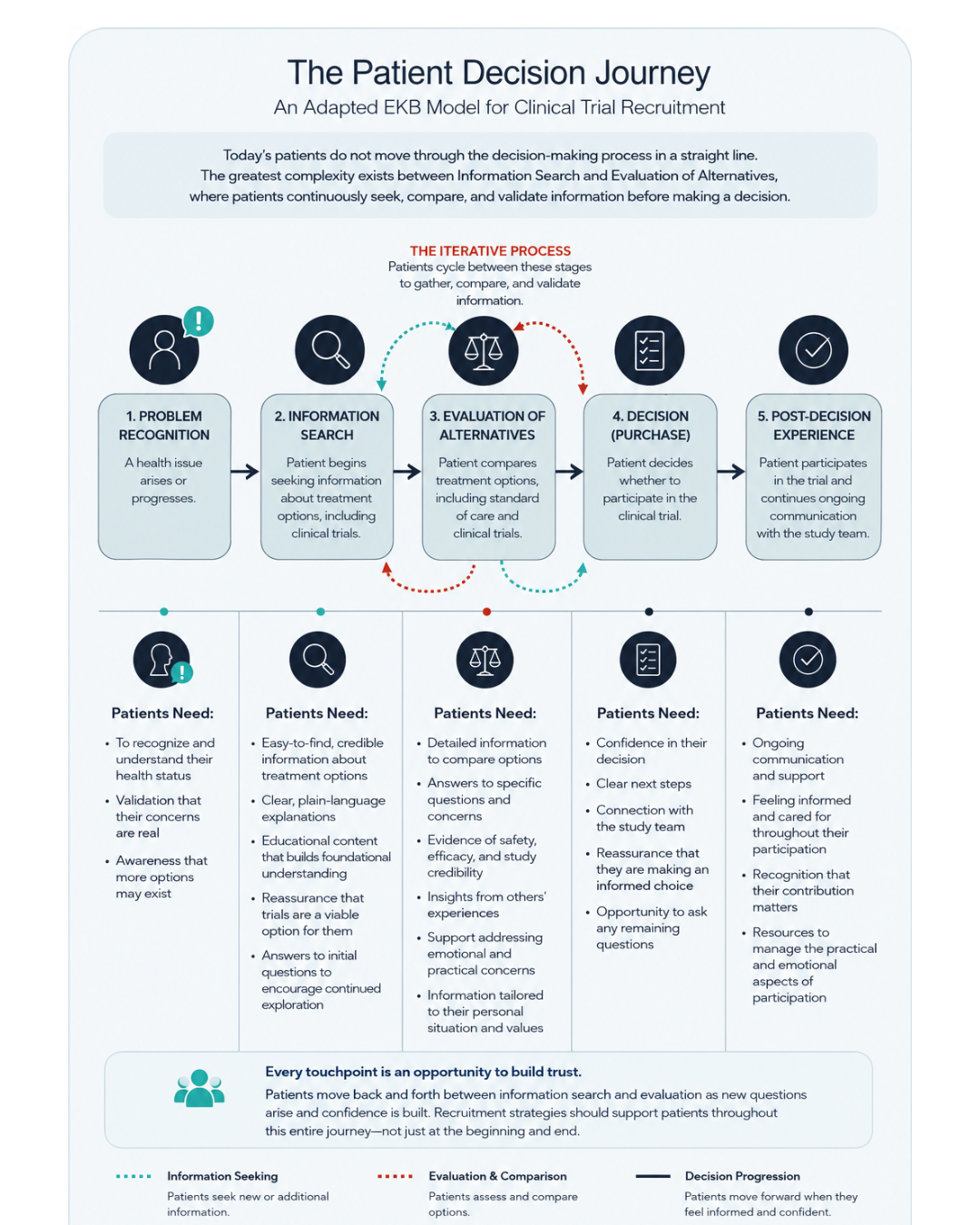
The first step in consumer behavior analysis is to map out the customer's journey. The Engel-Kollat-Blackwell (EKB) Model remains one of the foundational frameworks in consumer behavior and provides a useful lens for understanding the patient recruitment journey, particularly for oncology, chronic disease, and rare disease trials. This model starts with problem identification, that would be the patient's diagnosis, or time of progression of disease. Modern consumer behavior frameworks recognize that the greatest complexity in the consumer's journey exists between the next two phases, information search and evaluation of alternatives, considering the infinite access consumers and patients have to information through the internet, social media, and now AI. At these stages in the patient journey, they may have been presented with treatment options, and they would also take the time to seek, compare, and validate other options before committing to a decision. Study teams need to consider what patients need as they research their options, before they develop the recruitment tools and strategies.
Let's consider a patient who has just been told their cancer has progressed, and their doctor presented the standard of care option for the next line of treatment.
Starting with information search, study teams should consider what a patient needs at this stage to find their trial as a treatment option. Consider:
- Where would the patient go to find information on more treatment options?
- Is the trial searchable on those platforms?
- What information comes up if the trial is found?
- Is there enough information for the patient to take action?
- Is there enough information for the patient to move to the next step and compare the trial to alternatives?
Now let's say this patient finds the trial, and they move on to the evaluation of alternatives stage. Consider:
- What barriers consistently prevent eligible patients from participating?
- What information sources does this patient population trust most?
- What demographic, psychological, and behavioral factors influence their decision-making?
- How do patients compare clinical trials with other treatment options?
- What unmet informational or emotional needs exist?
- What factors increase a patient's confidence?
Consumer behavior modeling is ultimately about understanding how people make decisions and ensuring their needs are supported throughout the entire decision-making process. That is why successful marketing strategies begin by understanding the consumer journey before developing messaging, content, or communication plans. As consumer behaviors have evolved, marketing strategies have evolved alongside them, adapting to the digital platforms and information sources people already rely on to research, compare, and validate important decisions.
Clinical trial recruitment has an opportunity to evolve in the same way. BioStori is a concept built around applying these principles to clinical research by creating educational, authentic, and trust-centered digital content that supports patients throughout their decision journey. Rather than asking patients to navigate complex healthcare decisions with limited resources, BioStori aims to meet them on the platforms they already use to search for information, answer questions, build confidence, and ultimately support informed participation in clinical research.